
Cultural Lines in the Sand

+
JMJ


Cultural assumptions are the foundation upon which a culture stands (or falls).


What applies to large corporate organizations also applies to the Catholic Church.  There will, of course, be sub-cultures that operate within the larger culture of the organization.  Each of these sub-cultures will have some elements in common (forming the culture as a whole) as well as their own cultural assumptions.

An example of this can be found in the recent separation of some individuals from the SSPX.  In this case the cultural assumption that appears to have been challenged is either or both:

  1. Whether or not Pope Benedict XVI actually had the authority and capability to issue a legitimate command that would meet the criteria requiring obedience. 
  2. The assumption that the 'conciliar Church' refers to a movement within the Catholic Church.

The clarity and direction provided by the leadership of the SSPX has resulted in a reaffirmation of the two core assumptions and those people who hold contrary assumptions have in general separated themselves from the SSPX.  A number of those people have now revealed themselves as holding a variant of sede-vacantism.

In general terms there are at present two sub-cultures vying for dominance within the Catholic Church:

  1. Progressivists:  Hold cultural assumptions that have been dominant since the council, usually described as the 'spirit of the council'.
  2. Traditionalists: Hold cultural assumptions that were dominant  prior to the council, sometimes described as crypto-lefebvrist, lefebvrist, integrist.
There is a third sub-culture that basically is acquiescing to the dominant culture of the leadership.  I typically refer to this group as a hybridized Catholic/Protestant culture as its assumptions have been severely altered by the liturgy and progressivist culture dominant within the Church in the last 50 years. This cultural group is sometimes called 'conservatives' and what is going to be discovered soon is where is the line in the cultural sand beyond which they will not pass?

Obviously, the Traditionalists have already stated and stood by their various cultural lines (FSSP et al, SSPX  et al), with the attendant and predictable cultural immune responses.
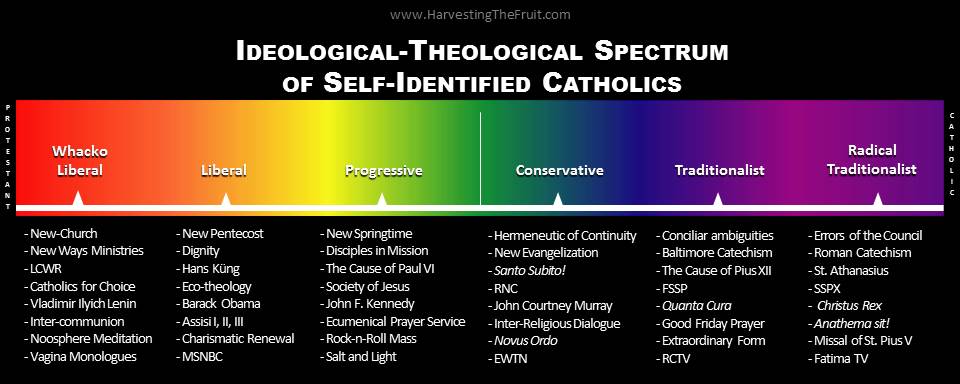
Which issue will be the rubicon for the conservatives?


What will the conservatives succeed in conserving in the coming Synod on the Family?

Will this be one of the defining moments in the history of this crisis?

God knows, time will reveal.

Until then ...

P^3
Prayer
Penance
Patience

Comments

Popular posts from this blog

The Curious Case of Steve Skojec and the Dangers of Deep Diving into the Crisis Sub-Titled: The Failings of Others

 + JMJ It's been a while now since Steve Skojec sold 1P5 and abandoned the Catholic Faith. I've been a 'Trad' since 1982 and in those 40+ years I seen this death-spiral before with a similar end point. It seems that anyone who jumps into the fray unprepared for the enormous task of righting wrongs will, eventually, become discouraged by not the task but the people who surround them.   I remember when Skojec complained of the treatment his family received from a traditional priest.  This seems to have been the start of the end for him. So what can we learn from the likes of Steve Skojec, Michael Voris (maybe?), Louie Verrecchio, Gerry Matatix and other celebrity Catholics? Probably quite a lot about what not to do. First, don't burn out on the crisis?  When you burn out, on work or anything else, little things assume a more greater importance than they are due.   This is one of my 'canary in the coal mine' signals that I've been stretching myself too th...

Dogmas of the Catholic Faith (de fide) - Expanded Listing

+ JMJ A friend had mentioned that he has seen a longer list of truths of the Faith than the one I posted here .  I have finally discovered it online. I have yet to completely determine what dogmas were missed in the original, those I have found are highlighted. Source: A List Of The Dogmas Of The Catholic Church - Fr. Carota Alternate Source: Referencing Ott   Posts Listing the Dogmas of the Catholic Church Dogmas of the Catholic Faith (de fide) - Expanded Listing: Answer for Reader (Oct 2022) Updated List of Teachings of the Catholic Church (Oct 2021) *** Dogmas of the Catholic Faith (Oct 2015) De Fide teaching of the Catholic Church (Apr 2013)           *** Latest version    

De Fide Teachings of the Catholic Church (Updated)

+ JMJ  Update: I was reviewing Ott's work directly and noted that some of the Teachings are De Fide while others are different levels of authority (such as Sent Certa etc).  So please refer to Ott for the actual classification). Posts Listing the Dogmas of the Catholic Church Dogmas of the Catholic Faith (de fide) - Expanded Listing: Answer for Reader (Oct 2022) Updated List of Teachings of the Catholic Church (Oct 2021) *** Dogmas of the Catholic Faith (Oct 2015) De Fide teaching of the Catholic Church (Apr 2013)           *** Latest version  

Homily vs Sermon

+ JMJ Something that I've noticed is that Modern Catholics use the phrase 'Homily' instead of 'Sermon'. I've often wondered about this difference. Here's what I found Catholic Encyclopedia (1910) Homily: ...Since Origen's time homily has meant, and still means, a commentary, without formal introduction, division, or conclusion, on some part of Sacred Scripture , the aim being to explain the literal, and evolve the spiritual, meaning of the Sacred Text.  ... Wikipedia Sermon: : A sermon is an oration , lecture , or talk by a member of a religious institution or clergy . Sermons address a scriptural, theological, religious, or moral topic, usually expounding on a type of belief, law, or behavior within both past and present contexts. Elements of the sermon often include exposition, exhortation, and practical application.   Catholic Encyclopedia (1910) Sermon: As to preaching at the present day, we can clearly trace the influe...

Becoming Traditional Catholic Part I

+ JMJ It is a big step from the non-Traditional to Traditional Catholic World. First of all, the Trad world is much smaller, isolated and under siege. This leads to a number of interesting elements that a person making the transition needs to take into account. The Trad World Is Smaller It is a fact that in the states there are about 30,000 Traditional Catholics who support the SSPX and about 3,000 in Canada.  The other Traditionalit orders (FSSP, ICK, etc), I assume, are in the same ball park if not smaller. Let put that in perspective, in my area there are 270,000 non-Traditional Catholics. Consequently, aside from the larger centers,  a Traditional 'Parish' or Mass Centre will be 200 people or less. This has the advantage of being like an extended family and cozy. It has the disadvantage that any crazy 'uncles' in that family will be in plain sight. Be forewarned that any eccentricity that would be drowned in a sea of people in a non-Traditiona...