Athanasius Smiled: Taking Back One of Our Places - The Remnant

+
JMJ

This has been development for a long time and worthy of celebration!


P^3


Redication Booklet

Courtesy of the Remnant


Athanasius Smiled: Taking Back One of Our Places Featured

Written by  
St. James the GreaterSt. James the Greater
In his letter to Catholics suffering at the hands of Arian heretics, the great St. Athanasius writes: "I know moreover that not only this thing saddens you, but also the fact that while others have obtained the churches by violence, you are meanwhile cast out from your places. For they hold the places, but you the Apostolic Faith." 
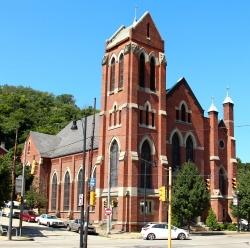
Today Athanasius smiled, for in the city of Pittsburgh, Pennsylvania in the United States of America a gathering of faithful Catholics witnessed a truly remarkable event: the dedication ceremony of new Catholic Church.
Now, by “new” I don’t mean to refer to the age of the actual building, for the West End parish of St. James the Greater was established in 1853. No, by “new” I mean in the sense that this building, which fell into disuse after the Second Vatican Council and was eventually sold off to a businessman to be used for secular purposes, has as of this morning been redeemed and rededicated to the holy purposes for which Catholics from many years ago had built it in the first place. The building is being placed back in the service of the Catholic Faith and the salvation of souls.
st. jamesThe Diocese of Pittsburgh may not be happy with this development but it is not difficult to imagine heaven rejoicing on this day, along with faithfulCatholics all around the world who see this as a heaven-sent sign of things to come if we can just hold fast to the faith of our fathers during these times of upheaval in the Church. 

To fully appreciate the long journey St. James has taken in order to reestablish the mission of salvation for which the church was built, readers may wish to peruse the SSPX’s 44-page St. James Church Re-Dedication commemorative brochure, which has been compiled by the new pastor of St. James, Father Patrick Rutledge, and can be viewed here

This morning, following a procession of priests and faithful through the streets of Pittsburgh, St. James Catholic Church at 326 S. Main Street was blessed at 11:00am by Fr. Niklaus Pfluger (First Assistant to the Superior General, Bishop Bernard Fellay). A Solemn Mass (see photo) followed, making it official: the SSPX has taken back one of ours but in a spirit of humility and gratitude to God for his goodness.
This day was a long time coming
james renovate
As the recent SSPX press release put it: 

For many years the Society of St. Pius X has performed its apostolic work for the salvation of souls under the auspices of Our Lady of Fatima Church. With the re-dedication of the new church the priestly society will continue its Pittsburgh, PA apostolate under the patronage of the Apostle, St. James the Greater. The retention of the church's original titular saint also signifies that the SSPX is continuing to transmit the same Catholic Faith for which the West End parish was founded in 1853.

As of tomorrow, March 29, Sunday Mass will once again be offered at St. James Church at 9:00am with confessions starting at 8:00am and the public rosary at 8:30am. The Mass, the Rosary, the Faith celebrated from now on in the Church of St. James will be according to the traditional Catholic Roman Rite of the Church. 

Whether you support the SSPX or not, we can all agree on this much: At least the Muslims didn't get this one, and Pittsburgh Catholics have not only kept the faith but managed to recover one of the churches that had been lost to us all.

All glory, laud and honor to Thee Redeemer King!

Comments

Popular posts from this blog

Comparision of the Tridentine, Cranmer and Novus Ordo Masses

+ JMJ I downloaded the comparison that was linked in the previous article on the mass (here) . ... a very good reference! P^3 From: Whispers of Restoration (available at this link) . CHARTING LITURGICAL CHANGE Comparing the 1962 Ordinary of the Roman Mass to changes made during the Anglican Schism; Compared in turn to changes adopted in the creation of Pope Paul VI’s Mass in 1969 The chart on the reverse is a concise comparison of certain ritual differences between three historical rites for the celebration of the Catholic Mass Vetus Ordo: “Old Order,” the Roman Rite of Mass as contained in the 1962 Missal, often referred to as the “Traditional Latin Mass.”The Ordinary of this Mass is that of Pope St. Pius V (1570) following the Council of Trent (1545-63), hence the occasional moniker “Tridentine Mass.” However, Trent only consolidated and codified the Roman Rite already in use at that time; its essential form dates to Pope St. Gregory the Great (+604), in whose time the R...

SSPX and the Resistance - A Comparison Of Ecclesiology

Shining the light of Church Teaching on the doctrinal positions of the SSPX and the Resistance. Principles are guides used to aid in decision making.  It stands to reason that bad principles will lead to bad decisions. The recent interactions between Rome and the SSPX has challenged a number of closely held cultural assumptions of people in both sides of the disagreement. This has resulted in cultural skirmishes in both Rome and the SSPX. Since it is the smaller of the two, the skirmishes have been more evident within the SSPX.  The cultural fault-line that Bishop Fellay crossed appears to be linked to two points of Catholic Doctrine: Ecclesiology and Obedience.  The cultural difference of view points is strong enough that it has resulted in the expulsion of a number of members.  It should also be noted that some other priests expelled since the beginning of the latest interactions (starting in 2000) held the same view points and have joined with the l...

If Pope Francis is bad - what about Pope St. John Paul II et al?

+ JMJ So here we are on the apparent cusp of yet another post conciliar Papal canonization. This time we have Pope's John-Paul I and Paul VI canonizations to 'look forward' to. This follows, obviously, on the heels of Pope St. John Paul II's canonization? So the first question that I usually encounter is: How is it possible, keeping in mind the doctrine on infallibility of canonizations (note doctrine not dogma), that Pope St. John Paul II is a Saint? First, what does it mean???  According to the doctrine of dogmatic facts - it is the universal opinion of Theologians that canonizations are infallible.  It means that they enjoy the beatific vision.  ... that's it.  That is the doctrine and it is at the level of universal opinion of theologians.  It is called a 'dogmatic fact'. That they made mistakes is obvious.  That the miracles seem to not be very miraculous is also a bit of an issue. Here's something to consider: The rush that surrou...

Spiritual Journey Archbishop Marcel Lefebvre - Extracts

+ JMJ I have posted these two chapters to provide context for the quote of: It is, therefore, a strict duty for every priest wanting to remain Catholic to separate himself from this Conciliar Church for as long as it does not rediscover the Tradition of the Church and of the Catholic Faith. P^3 Courtesy of SSPX.ca Chapter II The Perfections of God We ought to remember during this entire contemplation of God that we must apply all that is said of God to Our Lord Jesus Christ, Who is God. We cannot separate Jesus Christ from God. We cannot separate the Christian religion from Jesus Christ, Who is God, and we must affirm and believe that only the Catholic religion is the Christian religion. These affirmations have, as a result, inescapable conclusions that no ecclesiastic authority can contest: outside of Jesus Christ and the Catholic religion, that is, outsi...

Dogmas of the Catholic Faith (de fide) - Expanded Listing: Answer for Reader

 + JMJ  A reader asked the following question in the 2015 version of the article on the Dogmas of the Catholic Faith (link) : 117: "In the state of fallen nature it is morally impossible for man without Supernatural Revelation, to know easily, with absolute certainty and without admixture of error, all religious and moral truths of the natural order." Where can you find this in the documents of the Church? ( Link to comment )  Here's the reference from Ott: The citation that Ott provided was Denzinger 1786 and the source document is Dogmatic Consitution Concerning the Faith from the First Vatican Council (Papal Encyclicals - link) : Chapter 2 On Revelation, Article 3: It is indeed thanks to this divine revelation , that those matters concerning God, which are not of themselves beyond the scope of human reason, can, even in the present state of the human race, be known by everyone, without difficulty, with firm certitude and with no intermingling of error. Here's ...