
+
JMJ
December 7
Pharaoh would not let the Israelites leave Egypt so God sent sufferings; 10 plagues to encourage Pharaoh to change his mind.
Pharaoh was very stubborn, though and with each plague, he still refused to let the Hebrews go.
The 10 plagues were:
- water in the Nile River turned to blood
- frogs
- dust was changed to small insects
- flies
- a disease killed all the cattle
- sores called boils broke out on people and animals
- hail and lightning
- locusts (grasshoppers) ate all the plants
- darkness
- every first born Egyptian boy died.
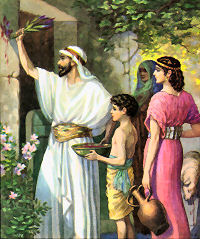 Before
God sent the tenth plague, He told the people of Israel that each
household must kill a lamb and spread its blood on the doorway of their
homes. When the angel of death went through Egypt, it would see the
blood of the lamb and pass over that house, sparing the boys inside. For
this reason that night was called the Passover. Every year, the Jewish
people celebrate the Passover in remembrance of that night in Egypt.
Before
God sent the tenth plague, He told the people of Israel that each
household must kill a lamb and spread its blood on the doorway of their
homes. When the angel of death went through Egypt, it would see the
blood of the lamb and pass over that house, sparing the boys inside. For
this reason that night was called the Passover. Every year, the Jewish
people celebrate the Passover in remembrance of that night in Egypt. In fact, Our Lord was celebrating the Passover with His 12 Apostles at the Last Supper; the night before His death. The Paschal lamb was a symbol of Our Lord, since He died to save all of mankind. St. John the Baptist called Our Lord, “Lamb of God”. Our Lord is the true Paschal Lamb, by Whose blood we are all redeemed.
Finally, after the tenth plague, Pharaoh agreed to let the Israelites go free. So 600 thousand men of Israel, together with their families and cows, sheep and goats all left Egypt together. That was ALOT of people!!!
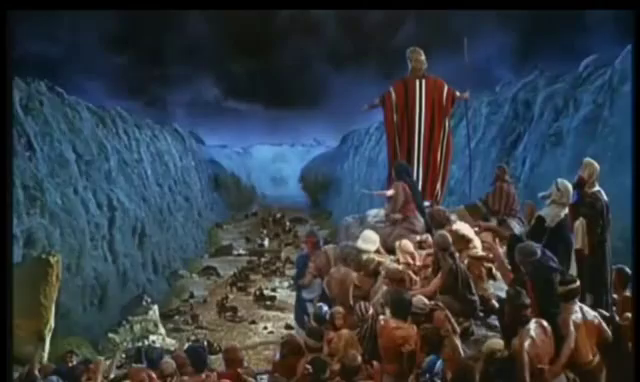 After the
Israelites had gone, Pharaoh changed his mind. He got his army together
and chased after them. The Israelites were on the shores of the Red Sea
when they saw Pharaoh's army coming in the distance. You can imagine
their panic! They had nowhere to run! Moses prayed to God for help and
God told Moses to stretch forth his rod. Then an amazing thing happened!
God made the waters of the Red Sea divide. A strip of dry land appeared
so that the people could go across. Imagine what it was like to
cross the sea, with towering walls of water on either side!
After the
Israelites had gone, Pharaoh changed his mind. He got his army together
and chased after them. The Israelites were on the shores of the Red Sea
when they saw Pharaoh's army coming in the distance. You can imagine
their panic! They had nowhere to run! Moses prayed to God for help and
God told Moses to stretch forth his rod. Then an amazing thing happened!
God made the waters of the Red Sea divide. A strip of dry land appeared
so that the people could go across. Imagine what it was like to
cross the sea, with towering walls of water on either side!Pharaoh and his army followed the Hebrews, right through the Red Sea. This was not a very smart move on his part…
Once the Israelites were safely across, God allowed the waters to return. Pharaoh and his army were drowned!
Now the Israelites were in the desert. God took care of His children. He guided them with a cloud by day and a pillar of fire at night. God sent them food from heaven, which formed on the ground every morning. When the Israelites first saw the strange sight, they all turned to each other saying “Manhu?” Manhu means, “What is this?” in Hebrew. So they called the food “Manna” from the word, “Manhu”. (Exodus 16)
God told the Hebrew people to gather only enough Manna for each day. Anything extra would spoil. God did this so that the people would come to trust in His loving Providence. This was the Hebrew’s daily bread; a prefigurement of our Daily Bread; God Himself, Food for our souls Whom we can receive every day in the Holy Eucharist!
Moses and the children of Israel made their way to Mount Sinai where they were supposed to make sacrifices to God. The offering of sacrifice was important because it helped them remember how much they owed to God. Also, for 400 years the Israelites had lived in a pagan land, surrounded by false gods. Some of those false gods had been calves, sheep and goats. By demanding the sacrifice of calves, sheep and goats, God was helping the Israelites to remember that these things were only creatures and to reject the false gods of Egypt.
When they reached Mount Sinai, God called Moses to come up the mountain alone to pray. God gave Moses the 10 Commandments; those laws He wanted His people to obey, written on tablets of stone. God also gave instuctions as to how the Isrealites were to worship Him.
/Moses-and-the-Ten-Commandments-GettyImages-171418029-5858376a3df78ce2c3b8f56d.jpg)
Moses stayed on Mount Sinai 40 days and 40 nights. While Moses was on the Mountain, the Israelites got restless. They made a false god; a statue of a golden calf and began to worship it.
When Moses returned and saw what was happening he threw down the stone tablets in anger and they broke.
With the help of the sons of Levi, who had remained faithful, Moses destroyed the idol and punished those who had worshiped the false god.
God commanded Moses to bring 2 more tablets of stone up the mountain and again engraved the Law on them.
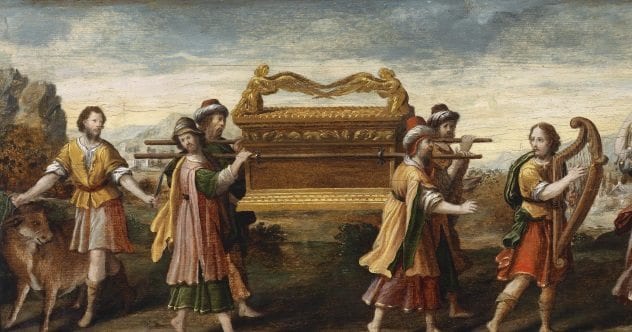 God
also commanded the Israelites to build the Ark of the Covenant; a
beautifully decorated chest. It held the treasures of God to His people;
the stone tablets of the 10 Commandments and some manna.
God
also commanded the Israelites to build the Ark of the Covenant; a
beautifully decorated chest. It held the treasures of God to His people;
the stone tablets of the 10 Commandments and some manna. To reward their faithfulness, the sons of Levi were made guardians of the Ark of the Covenant.
The Israelites also made a tent, called a tabernacle which would act as a house for the Ark, until they came to the promised land where they could build a proper temple.
That tabernacle was a symbol of the tabernacle on the altar in church where the Blessed Sacrament is kept; Our Lord Jesus Christ; God Himself!!
Comments
Post a Comment