
+
JMJ
December 14
Yesterday we read about King Saul. At first Saul was a good king, but then he disobeyed God.
God rejected Saul and commanded the prophet Samuel to find a new king for Israel.
“And the Lord said to Samuel…fill thy horn with oil, and come, that I
may send thee to Isai (Jesse) the Bethlehemite: for I have provided me a
king among his sons.” (1 Kings 16:1)
So Samuel went to Jesse in Bethlehem, and who do you think Jesse was?
He was the grandson of Booz and Ruth! (The "Jesse Tree" is named after this Jesse)
Jesse brought each of his seven sons to Samuel. They were all large men
and very impressive, but God told Samuel that He did not judge by the
outward appearance.
 And
when all seven sons had come, Samuel asked Jesse if these were all his
sons. Jesse replied that he had one more; a boy, who looked after the
sheep.
And
when all seven sons had come, Samuel asked Jesse if these were all his
sons. Jesse replied that he had one more; a boy, who looked after the
sheep.
Samuel told Jesse to bring him, and when he was come, God said that he was the chosen one. And the boy’s name was David.
So Samuel took the oil and anointed David, but it would be a few years yet until David actually became king.
In the meantime, Saul continued to rule Israel, but he was often
depressed and out of sorts because he had lost favour with God. Hoping
to find some peace for his troubled mind, Saul looked for someone who
could play the harp.
And it was told to Saul that the boy David could play. Hearing that David played the harp, King Saul sent for him.
At first Saul loved David. When Saul was sad David’s music made him feel better.
 David
was a gifted musician, and his songs were prayers to God. They can be
found in the Old Testament in the book of Psalms. The Hebrews call the
Psalms, “Hymns of Praise”. The psalms of David are sung during the
Divine Office by priests, monks and nuns.
David
was a gifted musician, and his songs were prayers to God. They can be
found in the Old Testament in the book of Psalms. The Hebrews call the
Psalms, “Hymns of Praise”. The psalms of David are sung during the
Divine Office by priests, monks and nuns.
Time passed and the Philistines began to attack Israel again. David’s
brothers joined Saul’s army and David returned home to take care of the
sheep. One day, the armies of the Israelites and the Philistines were
assembled for battle. The Philistines had a HUGE man in their army; a
giant named Goliath.
The Philistines challenged the Israelites to send out a man to fight Goliath. Whoever won the fight would win the war.
Now Goliath was BIG. Depending on the unit of measure at that time, he
was anywhere from 8 to 12.5 feet tall! His armor alone weighed a total
of 273 pounds! (See Haydock Catholic Commentary pg 361)
The Israelites did not know what to do! For 40 days they deliberated, but no one would volunteer to fight Goliath!
Then Jesse sent David to bring food to his brothers at camp. When David
got there, he heard about the problem they were having. Right then and
there, David offered to fight Goliath, for he trusted in God.
So taking his sling and five smooth stones, David went out to meet Goliath.
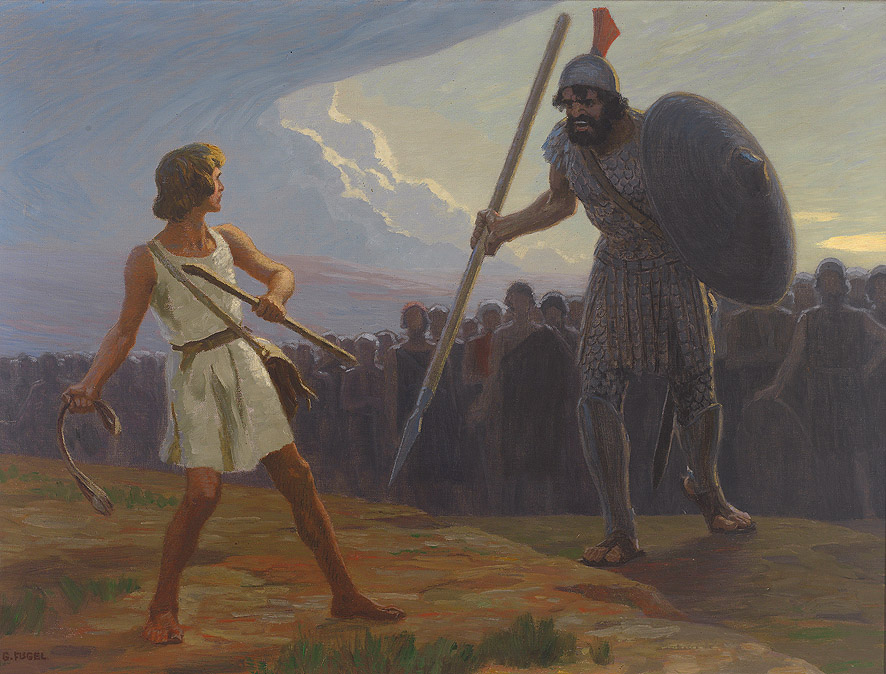
Seeing young David, Goliath cursed him, but David said to him, “I come
to thee in the name of the Lord of hosts…this day, and the Lord will
deliver thee into my hand, and I will slay thee, and take away thy head
from thee…” (1 Kings 17:45-46)
David took a stone and using his sling, hit the giant in the forehead.
Goliath crashed to the ground. Then taking the giant’s own sword, David
cut off his head. And taking his head, David carried it away. (Remember
the promise of God in Genesis 3:15? Here is another example of “head
crushing”)
From that time on, David lived with King Saul and did not return home.
And David became close friends with King Saul's son, Jonathan so that
they were like brothers.
Time passed and David grew strong. Saul put him in charge of leading his armies.
David won many battles, and the people sang;
“Saul slew his thousands, and David his ten thousands”
When Saul heard this, he grew angry, and jealous of David. Saul even
tried to kill David, but Jonathan helped his friend escape.
Many times after that, Saul tried to kill David, but David would not fight the king or do him any harm.
Finally, Saul came to a sad end. In despair, he killed himself during a
battle, falling upon his sword. This brings us to the end of the first
book of kings.
Comments
Post a Comment