
Advent Series December 20


+
JMJ

December 20


 In our study of Old Testament history, we’ve seen how after the reign of Solomon, the Hebrew people divided into 2 kingdoms. 10 tribes broke away and formed the Kingdom of Israel in the north. Their king, Jeroboam, did not want his people to go to Jerusalem to worship God, so he set up the golden calf idols at Bethel and Dan.

The kingdom of Israel was eventually taken over by the Assyrians and the people were forced to leave their homes. They were dispersed all over the world, becoming the “Lost Tribes of Israel”.

The other kingdom was the Kingdom of Judah. The Kingdom of Judah was made up of 2 tribes; Judah and Benjamin.

The Assyrians tried to take over Judah as well, but as we read yesterday, Judith killed the Assyrian general, Holophernes and for some time they were left in peace.

The Assyrians were busy elsewhere, however. They fought many battles and lost many men. They needed new soldiers to fight their wars, so they forced the people they conquered to fight for them. Naturally, these people were not very eager to fight. Assyria’s power was fading.

In 612 B.C., the Chaldeans took over Assyria, as well as the lands the Assyrians had conquered. The Chaldeans rebuilt the city of Babylon and brought back the Babylonian way of life. For this reason they are sometimes called Babylonians.

In the year 597 B.C. the Chaldeans did succeed in taking over Judah. 

They forced many Jews to go to Babylon. 
In 586 B.C. the Chaldeans destroyed Jerusalem. Only the poorest Jews were left behind to plant crops.

This was the time of the “Babylonian Captivity.”

Among those who were taken captive was a man named Daniel. Daniel was a prince of the Tribe of Judah; from the kingly line of David.

The Chaldean king, Nebuchadnezzar wanted a few of the best Jews to come and live at his palace so that those Jews might learn the ways of the Chaldeans. He chose Ananias, Misael, Azarias and Daniel.

One night King Nebuchadnezzar had a dream, but he could not remember it very well. Of all the wise men at the king’s court, only Daniel, with God’s grace was able to tell the king what his dream was and what it meant. The dream foretold the rise and fall of the kingdoms of Persia, of Alexander the Great and the Roman Empire, as well as the coming of the eternal kingdom of God; the kingdom of Our Lord Jesus Christ: 


“… in the days of those kingdoms, the God of Heaven will set up a kingdom that shall never be destroyed…it shall consume all these kingdoms, and itself shall stand forever.” (Dan 2:44)

Because of Daniel’s wisdom, King Nebuchadnezzar gave Daniel authority and power in Babylon. The other 3 Jewish men; Ananias, Misael and Azarias became governors of the provinces in Babylon. (The Chaldeans changed their names in the process, which makes this part a little confusing.).

Then one day King Nebuchadnezzar made a big idol and told everyone they had to worship it or else. Of course Ananias, Misael and Azarias would not do such a thing, so the king ordered them to be put into a furnace of burning fire.

“But the angel of the Lord went down with Azarias and his companions into the furnace: and he drove the flame of the fire out of the furnace, and he made the midst of the furnace like the blowing of a wind bringing dew…” (Dan3:49-50) And the 3 men sang a canticle to God praising Him for His mercies.

Incidentally, this part of history can be found in the missal for the Mass of Ember Saturday during Advent!

After some time, a new king, King Baltassar reigned in Babylon. This king had a big feast. While he and his guests were eating and drinking from the sacred vessels which had been stolen from the Temple of Jerusalem, a hand appeared and wrote 3 words on the wall; MANE THECEL PHARES

Daniel told the king that:
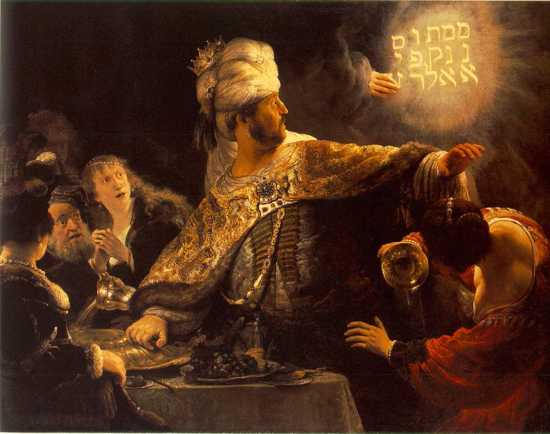


MANE meant that God would put an end to the king’s kingdom.
THECEL meant “Thou art weighed in the balance and found wanting”
PHARES meant that his kingdom would be divided and given to the Medes and Persians.


That same night, King Baltassar died.

Darius, the Mede, became the next king. (Dan 5) King Darius liked Daniel very much and wanted to put him in charge of his kingdom. This made the other men in power jealous and they looked for a way to get rid of Daniel. Tomorrow we will see what happened next!

Today’s O Antiphon is “O Clavis David”

“O Key of David, and Scepter of the house of Israel, Who openest and no man shutteth; Who shuttest and no man openeth; come and lead the captive from the prisonhouse, him that sitteth in darkness and in the shadow of death.”

It was prophesied that the Saviour would be of the line of King David (hence the “O key of David”). By dying on the cross, Our Lord would reopen the gates of heaven.

Comments

Popular posts from this blog

Comparision of the Tridentine, Cranmer and Novus Ordo Masses

+ JMJ I downloaded the comparison that was linked in the previous article on the mass (here) . ... a very good reference! P^3 From: Whispers of Restoration (available at this link) . CHARTING LITURGICAL CHANGE Comparing the 1962 Ordinary of the Roman Mass to changes made during the Anglican Schism; Compared in turn to changes adopted in the creation of Pope Paul VI’s Mass in 1969 The chart on the reverse is a concise comparison of certain ritual differences between three historical rites for the celebration of the Catholic Mass Vetus Ordo: “Old Order,” the Roman Rite of Mass as contained in the 1962 Missal, often referred to as the “Traditional Latin Mass.”The Ordinary of this Mass is that of Pope St. Pius V (1570) following the Council of Trent (1545-63), hence the occasional moniker “Tridentine Mass.” However, Trent only consolidated and codified the Roman Rite already in use at that time; its essential form dates to Pope St. Gregory the Great (+604), in whose time the R...

SSPX and the Resistance - A Comparison Of Ecclesiology

Shining the light of Church Teaching on the doctrinal positions of the SSPX and the Resistance. Principles are guides used to aid in decision making.  It stands to reason that bad principles will lead to bad decisions. The recent interactions between Rome and the SSPX has challenged a number of closely held cultural assumptions of people in both sides of the disagreement. This has resulted in cultural skirmishes in both Rome and the SSPX. Since it is the smaller of the two, the skirmishes have been more evident within the SSPX.  The cultural fault-line that Bishop Fellay crossed appears to be linked to two points of Catholic Doctrine: Ecclesiology and Obedience.  The cultural difference of view points is strong enough that it has resulted in the expulsion of a number of members.  It should also be noted that some other priests expelled since the beginning of the latest interactions (starting in 2000) held the same view points and have joined with the l...

If Pope Francis is bad - what about Pope St. John Paul II et al?

+ JMJ So here we are on the apparent cusp of yet another post conciliar Papal canonization. This time we have Pope's John-Paul I and Paul VI canonizations to 'look forward' to. This follows, obviously, on the heels of Pope St. John Paul II's canonization? So the first question that I usually encounter is: How is it possible, keeping in mind the doctrine on infallibility of canonizations (note doctrine not dogma), that Pope St. John Paul II is a Saint? First, what does it mean???  According to the doctrine of dogmatic facts - it is the universal opinion of Theologians that canonizations are infallible.  It means that they enjoy the beatific vision.  ... that's it.  That is the doctrine and it is at the level of universal opinion of theologians.  It is called a 'dogmatic fact'. That they made mistakes is obvious.  That the miracles seem to not be very miraculous is also a bit of an issue. Here's something to consider: The rush that surrou...

Spiritual Journey Archbishop Marcel Lefebvre - Extracts

+ JMJ I have posted these two chapters to provide context for the quote of: It is, therefore, a strict duty for every priest wanting to remain Catholic to separate himself from this Conciliar Church for as long as it does not rediscover the Tradition of the Church and of the Catholic Faith. P^3 Courtesy of SSPX.ca Chapter II The Perfections of God We ought to remember during this entire contemplation of God that we must apply all that is said of God to Our Lord Jesus Christ, Who is God. We cannot separate Jesus Christ from God. We cannot separate the Christian religion from Jesus Christ, Who is God, and we must affirm and believe that only the Catholic religion is the Christian religion. These affirmations have, as a result, inescapable conclusions that no ecclesiastic authority can contest: outside of Jesus Christ and the Catholic religion, that is, outsi...

Dogmas of the Catholic Faith (de fide) - Expanded Listing: Answer for Reader

 + JMJ  A reader asked the following question in the 2015 version of the article on the Dogmas of the Catholic Faith (link) : 117: "In the state of fallen nature it is morally impossible for man without Supernatural Revelation, to know easily, with absolute certainty and without admixture of error, all religious and moral truths of the natural order." Where can you find this in the documents of the Church? ( Link to comment )  Here's the reference from Ott: The citation that Ott provided was Denzinger 1786 and the source document is Dogmatic Consitution Concerning the Faith from the First Vatican Council (Papal Encyclicals - link) : Chapter 2 On Revelation, Article 3: It is indeed thanks to this divine revelation , that those matters concerning God, which are not of themselves beyond the scope of human reason, can, even in the present state of the human race, be known by everyone, without difficulty, with firm certitude and with no intermingling of error. Here's ...